
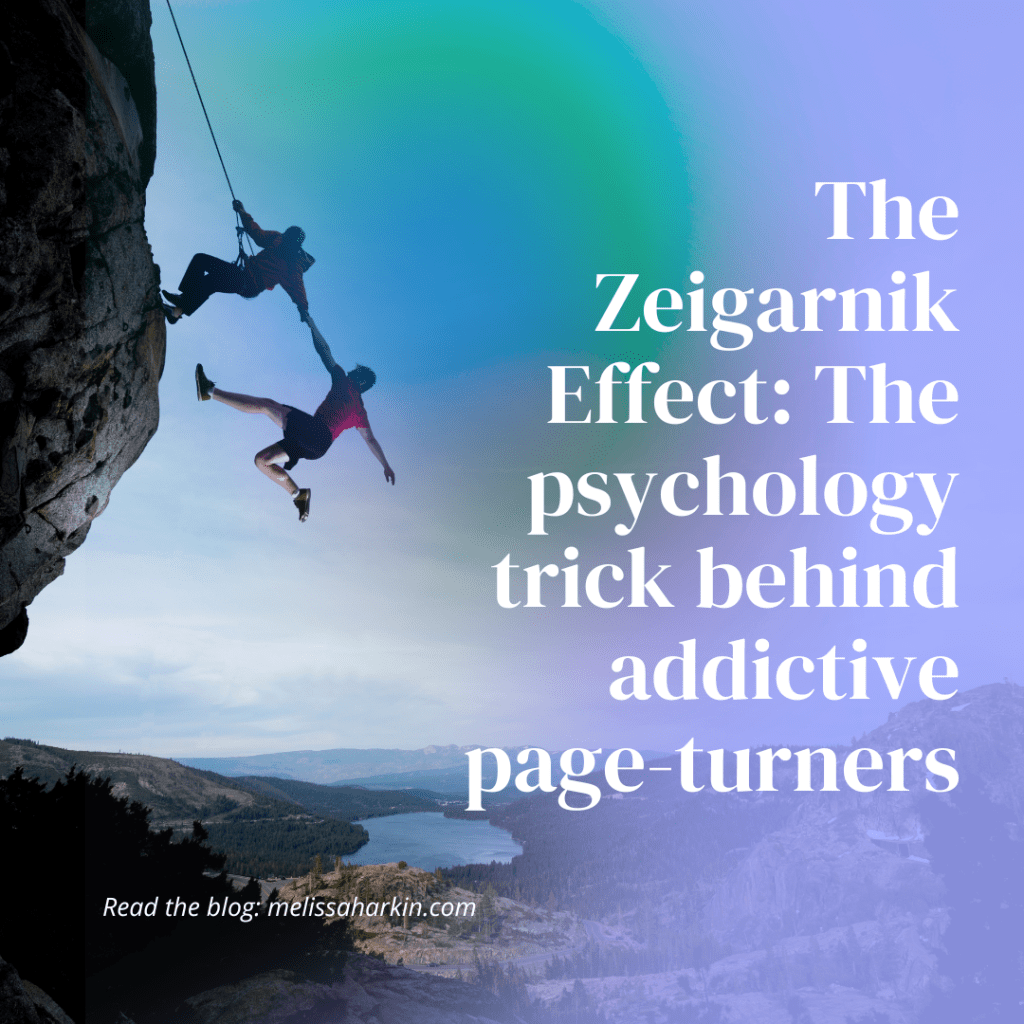
You know that feeling when you’re about to put a book down, and then suddenly the last sentence of the chapter hits you like a punch to the face?
Boom. You’re hooked. Goodbye sleep. Hello “just one more chapter.”
That’s the Zeigarnik Effect working its magic.
So what is the Zeigarnik Effect?
Back in the 1920s, a Russian psychologist named Bluma Zeigarnik noticed that waiters remembered unfinished orders better than completed ones. She realized that our brains are wired to hold onto things that aren’t resolved. Incomplete tasks—or cliffhangers—take up more mental space than finished ones.
Translation? Unfinished business = mental stickiness.
What does this mean for your writing?
It means that if you want readers to binge your book, obsess over your series, or stay up until 3 AM whispering, “Okay, now I’ll stop,” you need to tap into this effect.
And it’s easier than you think.
Cliffhangers are brain glue
Here’s how to use the Zeigarnik Effect in fiction:
- End chapters on questions. Leave something unresolved. A door opens. A phone rings. A secret slips.
- Cut a scene mid-action. Don’t resolve the fight, the kiss, or the shocking reveal just yet.
- Break up emotional arcs. Let characters almost have the conversation, almost say the thing, almost kiss. Almost.
You’re not being mean. You’re giving the reader’s brain a juicy little itch that only turning the page can scratch.
The Zeigarnik Effect in chapter design
Every chapter doesn’t need to end with a literal explosion. But it should end with momentum. That can be tension, curiosity, dread, or even a delicious promise.
The worst thing you can do at the end of a chapter? Tie everything up with a bow. If the conflict is too neatly resolved, the reader’s brain thinks, “Cool. That’s a good place to stop.” And you never want to give your reader permission to stop.
So instead of wrapping things up, leave the ribbon dangling.
Bonus: Use it in your author newsletter
This works outside the page too. Try ending your emails or blog posts with:
- “Next week, I’ll show you how I completely rewrote my ending after my beta readers revolted.”
- “In my next newsletter, I’m spilling my favorite rejection story.”
- “Part 2 is coming next Friday, and it’s way juicier.”
- Next week I’ll post about the Pygmalion Effect and how character beliefs can shape powerful arcs (see what I did there? 😉)
Leave a breadcrumb trail, and readers will follow it.
TL;DR
- The Zeigarnik Effect = we remember what’s unfinished
- Apply it to your chapter endings to keep readers turning pages
- Cliffhangers aren’t just drama; they’re neuroscience
- Leave loops open to keep readers hooked
You want to write books that readers can’t quit? Keep them wanting answers.



 Melissa Harkin
Leave a comment